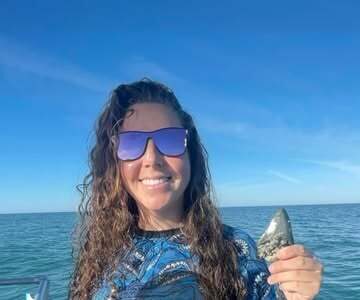
Why Venice is the place for fossil diving
People fly in from other states for this. Millions of years ago, when Florida was underwater, the seabed off Venice was collecting the teeth sharks shed by the thousand. That sediment compressed into a phosphate-rich fossil layer that now sits roughly 15 to 35 feet below the surface, a short boat ride out. Storm energy keeps freeing teeth from the formation and driving the heavier ones toward shore — which is why the beach itself is famous, and why the diving is even better.
Locals know the productive stretch as the Boneyard: an area running about five miles south from the South Venice jetties, reachable only by boat. A dive there is an anchor dive, not a drift — you settle onto the bottom, fan the sand away by hand, and pick out what the sand kept.
What a guided shark tooth dive is actually like
Honest expectations matter more than hype here, so here’s the real shape of a Gulf fossil dive:
- You hunt by feel. Visibility in the Gulf typically runs 5–8 feet. You fan the light sand away and wait for your fingers to find something heavier — a fossil tooth sitting in your hand before you can see it happens constantly.
- The dives are shallow and forgiving. At 15–35 feet there’s no decompression obligation and long bottom time. Current is usually negligible. Depth is not what makes this dive challenging.
- It’s a working dive, not a sightseeing dive. Most operators run two or three tanks across a half day on the water. You’ll be busy the whole time.
- Local knowledge is the whole game. Files and tide have covered and uncovered the same spots for years. After enough time on the bottom you learn which sand tells you something — that’s what you’re booking a guide for.
What you might bring up
- Megalodon (Otodus megalodon) — the trophy. Teeth commonly 3 inches and up, with trophy-grade specimens over 7 that are graded on tip, serration, color, and enamel.
- Mako, great white, tiger, bull — larger, prized teeth, often with serrations intact.
- Lemon, dusky, hammerhead, sand tiger, snaggletooth — the everyday finds, most under an inch.
- Ray dental plates and stingray barbs, plus invertebrate and plant fossils — all keepable with no permit.
- Vertebrate fossils — dugong ribs, whale bone, horse and mammoth teeth. These are the regulated ones (see below).
Permit rules, plainly: shark teeth, ray teeth, invertebrate, and plant fossils need no permit — take them home freely from the beach, rivers, or seabed. Ice Age vertebrate fossils (mammal bone, dugong ribs, whale bone) collected on state land require the $5-per-year Florida Fossil Permit issued by the Florida Museum of Natural History, and significant finds can be claimed by the State inside a 60-day window.
Who can do this dive
The scuba dives require a minimum Open Water certification — bring your card, physical or app. Because it’s shallow, it’s genuinely beginner-friendly, and Kaitlyn has guided divers from age 10 to 80 onto the fossil beds.
Two honest caveats. If you haven’t dived in six months or more, this is not the dive to re-acclimate on — low visibility and a task-loaded bottom make it a poor warm-up. Do a refresher first; Kaitlyn teaches them. And if you’re not certified yet, she can take you all the way through Open Water certification and then out to the fossil beds, which is the order most people do it in.
Conditions by season
| Season | Water temp | What to expect |
|---|---|---|
| May – September | 76–90°F | Warmest water, easiest diving. 3mm or a skin suit for many divers. |
| October & April | 70–76°F | Comfortable shoulder season; a 5mm is usually right. |
| November & March | 66–70°F | Cooler — bring a thicker wetsuit and a hood. |
| December – February | 62–66°F | Coldest Gulf water. 7mm plus a hood or hooded vest, and you’ll want your gloves. |
What to bring
Your own complete, working dive kit is what’s expected: mask, fins, BCD, regulator, dive computer, wetsuit appropriate to the season, whistle, and a surface marker buoy. Add a compass — it matters more than usual when visibility is measured in feet — a mesh goody bag for your teeth, and a small light if you want to see into the sand. Gloves are optional but popular. Tanks and weights are the items you should ask about when you book, along with rental availability.
Diving with Kaitlyn
Kaitlyn Fay is a PADI and NAUI Open Water Scuba Instructor and a USCG-licensed 25-ton Master Captain — she has run dive charters as captain, managed a boat club, teaches up to Divemaster level, and has certified close to 200 divers. She teaches the fossil-hunting specialty herself, and she’s a good pick if you’d rather learn the water with a patient instructor than get handed a bucket and pointed at the Gulf.
She also runs Open Water certification, private lessons, continuing education, refreshers, and captain services out of Venice — so a shark tooth dive can be the first thing you do after certification, or a standalone trip with your own gear.
Get on the calendar
Send your dates and certification level. Kaitlyn replies personally with current rates, what’s included, and a day that works with weather and tides.